Gwynplaine’s Speech to the House of Lords
The Man Who LaughsAt his first appearance in the House of Lords, Gwynplaine uses the identity imposed on him by power and spectacle to speak against the social order that has elevated the peers and abandoned the poor. His address begins as a plea for the suffering below them, becomes a disclosure of his own history, and ends with the chamber laughing at the very face through which he means to make suffering visible. The scene makes his social critique inseparable from the bodily stigma that the lords treat as entertainment.
The peer takes the floor
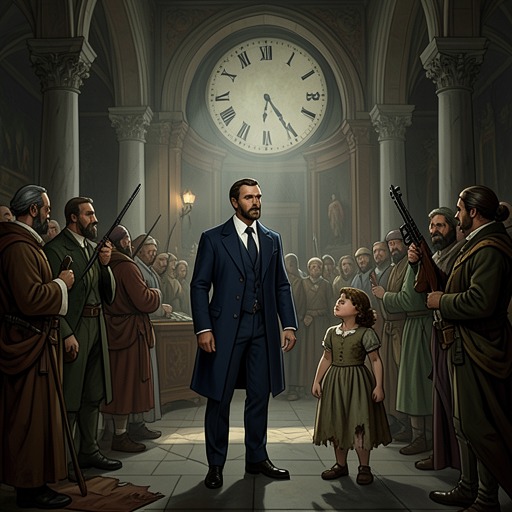
The clerk, after hesitating over the register, announces Gwynplaine by his new title: Lord Fermain Clancharlie, Baron Clancharlie and Hunkerville. Gwynplaine rises and records his dissent with a single formal vote, then remains standing as every face turns towards him. The candles illuminate his features against the dark chamber. Before speaking, he manages an extraordinary act of self-command: for a short time he suppresses the fixed grin. The effort is precarious, and the narration compares its brief resistance to a force that can rise against gravity only to fall back again.
His first words place him not among the powerful but among the miserable. He tells the lords that their wealth, authority, and insulation from the lives of others have left them ignorant of humanity beyond their own rank. His claim is not simply that poverty exists; it is that the privileges visible in the chamber depend on suffering kept out of its sight. He presents his arrival as a warning, arguing that a society built on the deprivation of its neighbours cannot remain secure. The peerage gives him access to the chamber, but he treats that access as an occasion to challenge the basis of its authority.
An indictment grounded in lived experience
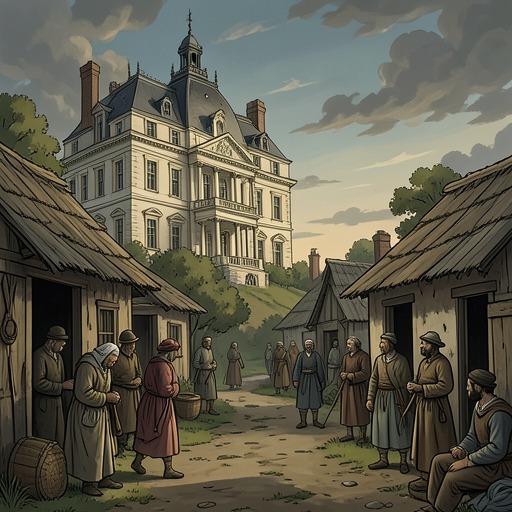
Gwynplaine describes the ascent from yesterday’s mountebank to today’s peer as a reversal whose cause is unknown to him. He contrasts the lords’ view of the sunlit world with the shadows they do not see, and identifies his own name, Gwynplaine, with the poverty from which his new title cannot detach him. His father’s feudal connection to the peers and his outlawry link the family history to the political order under examination; Gwynplaine says he never knew his father. He presents his own experience of cold, hunger, contempt, sickness, and shame as knowledge acquired from below, not as an abstract argument learned at court.
To make that knowledge concrete, he recalls the first things encountered by an abandoned child entering society during a storm: the law represented by a gibbet, wealth by a woman dead from cold and hunger, the future by another child left to die, and goodness and justice by a vagabond accompanied by a wolf. The sequence turns institutions and ideals into encounters with human consequences. It also reverses the chamber’s elevated perspective: what the peers can overlook is, for the child, society’s first and defining lesson.
He then urges the lords to consider their responsibility as well as their power. His appeal describes a social structure in which one group’s weight presses down on another, while those above mistake their position for proof of superiority. He invokes people trapped without hope, severe punishments, and workers whose hunger is so extreme that they chew coal. He names Newcastle-upon-Tyne and Lancashire, including Ribblechester, as places where poverty is present in particular forms. He questions the allocation of public resources to Prince George of Denmark while sick people must face funeral expenses in advance to enter a hospital. These examples broaden the speech from personal testimony into an accusation about policy, taxation, and the distribution of wealth.
The grin as evidence and obstacle
The speech is repeatedly shaped by a conflict between what Gwynplaine means and what his face makes the audience see. His permanent expression was produced by an intervention in childhood; whatever he feels, the face appears to laugh. At the House of Lords, the attempt to hold that expression in check cannot last. When emotion rises in his throat, the grin returns as uncontrollable laughter. The mismatch gives the peers an easy way to dismiss his appeal: they respond to his face as a comic performance rather than to his words as testimony.
At first, his account brings a shudder and silence. Once the laughter begins, however, it spreads through the chamber. The lords answer his denunciation with applause, jeers, and comic names recalling his life as an entertainer in the Green Box and his appearances at Tarrinzeau Field. Their response converts his political speech into a spectacle, echoing the crowds who had laughed at his face before turning away from it. In the House, laughter serves a more public and powerful function: it lets the peers make his grief appear ridiculous and avoid the substance of his charge.
Gwynplaine tries to regain their attention by insisting that they are judging their own actions. He asks them to imagine themselves weighed against their responsibility and argues that the distinction between oppressor and oppressed is a difference of position, not of human nature. He calls on them to act as brothers and to show tenderness, rather than treating their rank as a licence to ignore suffering. But his appeal continues to meet a divided reception: the words plead for recognition while the involuntary expression provokes laughter. The narration emphasizes the humiliation of being tragic inwardly and comic to those watching.
Identity, collapse, and adjournment
As the derision continues, Gwynplaine makes the contradiction of his public identity explicit. He is Lord Clancharlie, yet still Gwynplaine; admitted among the great, he says he belongs with the poor. He distinguishes the king who marked his face from the poor man who sheltered and nourished him. The contrast gives his political argument a personal history: authority has been capable of making him an emblem of suffering, while care came from outside the ranks that now mock him. He calls the grin a sign of enforced silence, rage, and despair, and presents his altered appearance as a figure for a people whose rights and capacities have also been deformed by their masters.
His vision extends beyond the immediate chamber. He predicts that the apparent solidity of oppression can melt and that the people may rise against the order that keeps them beneath it. He recalls the Republic and Oliver Cromwell as evidence that royal power has been broken before, and imagines a future without lords, masters, or kings. The speech thus moves between immediate appeal and political prophecy. Its argument is not accepted by the assembly: the peers’ laughter grows, and their mockery becomes the principal event of the scene.
Gwynplaine can no longer master either his expression or his audience. The House of Lords’ response reverses the reception he had known as a performer: applause that once drew crowds to the Green Box becomes derision directed at Lord Fermain Clancharlie. The Lord Chancellor adjourns the sitting until the next day because of extraordinary circumstances. The peers depart amid echoes of laughter, and the chamber empties. The adjournment interrupts the proceedings without answering Gwynplaine’s charges; the immediate result is not reform or recognition, but the public defeat of his attempt to make the powerful listen.